
Catawba County Criminal Case Files
Criminal court records in Catawba County are maintained by the Clerk of Superior Court for both Superior Court and District Court. The criminal file begins once charges are filed with the court and can grow through hearings, motions, plea negotiations, trial, disposition, sentencing, payment, probation, appeal, and post-judgment filings. For a closer look at the charging step itself, use the separate Catawba County arrest records and charges resource.
District Court handles below-felony criminal actions, preliminary examinations, bail and commitment orders, many misdemeanors, infractions, and traffic-related criminal matters. Superior Court handles felony criminal actions not assigned to District Court and appeals from District Court. Catawba County is listed by the NC Judicial Branch as Prosecutorial District 36, Superior Court District 19, and District Court District 36.
The District Attorney prosecutes criminal cases for the State. The official DA site for Burke, Caldwell, and Catawba counties identifies Scott Reilly as District Attorney in the research materials, while the court directory lists the Catawba County DA phone line at (828) 695-6110.
The manifest image from the District Attorney website connects the criminal court records page to the prosecutor role in pleas, dismissals, indictments, and sentencing advocacy.
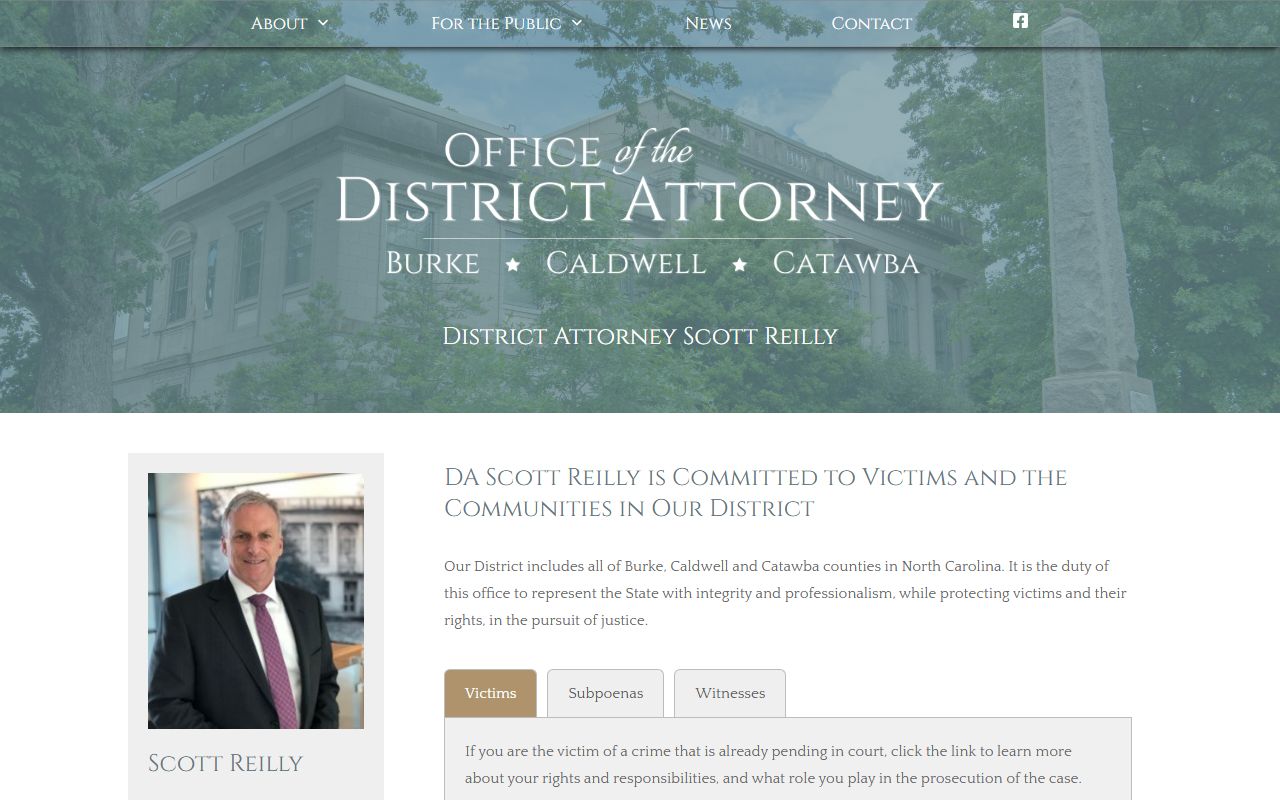
That office does not keep the public court file, but its charging and prosecution decisions shape what appears in the criminal docket.
Search Catawba Criminal Court Records
Start with the NC eCourts Portal for Smart Search and Search Hearings. Public terminal access at the Clerk of Superior Court remains important because NCAOC says criminal cases can be searched at clerk offices by defendant name, case number, or victim and witness name. A criminal background check should be done through the county clerk rather than through Portal alone.
- Open the Portal and use Smart Search for case information or Search Hearings for criminal court dates.
- Search by defendant name, case number, citation number, attorney, or other supported criminal-case fields.
- Check whether the result is in District Court, Superior Court, or an out-of-county court listed in the record.
- Read the charges, hearing history, disposition, sentence, costs, and any document links that are public.
- Request certified copies from the Clerk of Superior Court when an official document is needed.
If the case is tied to jail custody, the jail roster may show docket numbers and court dates, but it is not the full criminal case file. For statewide prison, probation, parole, SAVAN, or sex-offender links, use the NC Department of Adult Correction offender search channels described in the research.
Catawba Criminal Court Process
A Catawba County criminal court record changes as the case moves. Charges may be filed by citation, warrant, criminal summons, information, or indictment. Arraignment handles formal charge and plea steps. Pretrial entries can include bond, discovery, motions, continuances, and plea discussions. A case may resolve by dismissal, plea, trial verdict, deferred prosecution, probation, active sentence, or appeal.
Case flow: Charges Filed › Arraignment › Pretrial / Motions › Plea or Trial › Disposition › Sentencing
| Stage | What Happens |
|---|---|
| Charges filed | The case opens with a charge, citation, warrant, summons, information, or indictment. |
| Arraignment | The charge is formally addressed and plea handling may begin. |
| Pretrial and motions | Bond, discovery, continuances, suppression motions, and plea discussions can appear. |
| Plea or trial | The case resolves by plea, bench trial, jury trial, dismissal, or other disposition. |
| Sentencing | The record may show costs, fines, restitution, probation, active time, or other conditions. |
The image from G.S. 7A-271 supports the Superior Court role in criminal jurisdiction.
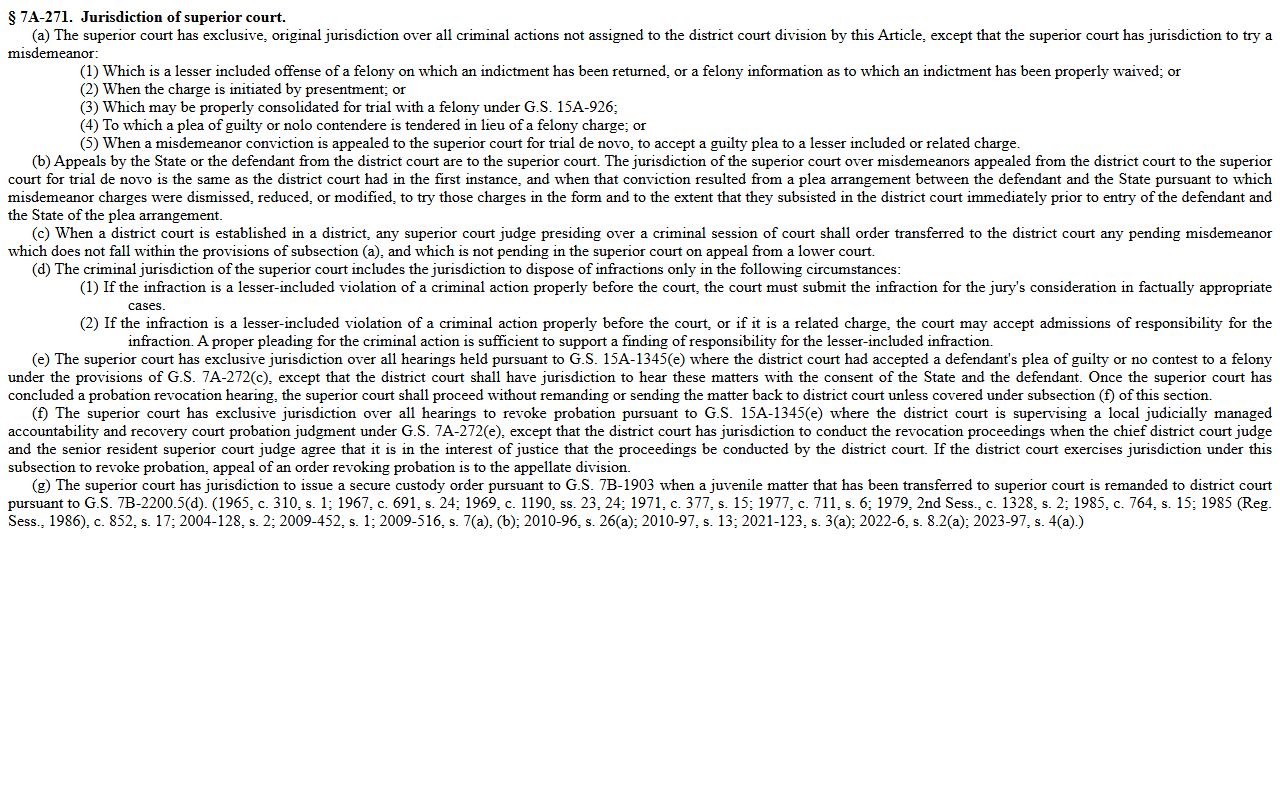
Felony jurisdiction and appeals from District Court explain why some criminal records move through Superior Court.
Catawba Criminal Record Fields
A criminal court record can include more than the charge name. It may identify the court, docket number, defendant, prosecutor, defense counsel, agency, bond, hearing dates, filed documents, judgments, sentence, financial obligations, and access restrictions. Some details are visible online; others require a terminal or paper file at the Clerk of Superior Court.
| Field | What It Shows |
|---|---|
| Case number | The docket number used for search, hearings, payments, and copy requests. |
| Defendant | The person charged, with identifying details limited by public-access rules. |
| Charges | The alleged offense, level, statute reference, agency, and current charge status where shown. |
| Plea | The defendant's formal response, such as guilty, not guilty, or other plea handling. |
| Disposition | The outcome, such as dismissed, guilty, not guilty, deferred, disposed, appealed, or closed. |
| Sentence | Probation, active sentence, fines, costs, restitution, conditions, or post-judgment orders. |
The image from G.S. 7A-272 anchors District Court criminal jurisdiction for lower-level criminal cases.
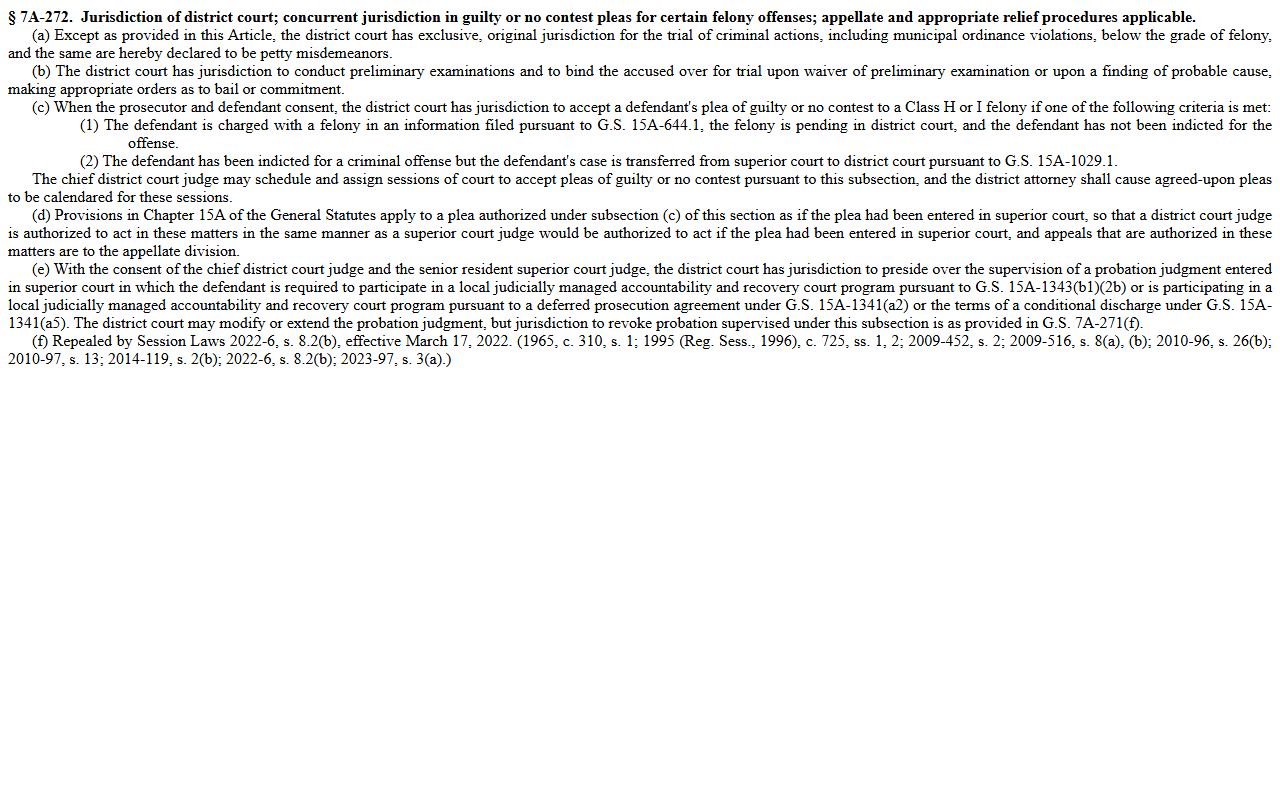
District Court jurisdiction is central to misdemeanor, infraction, bail, and preliminary criminal entries in Catawba County records.
Catawba Charges vs Convictions
A charge is an accusation. A conviction is an outcome after a guilty plea, verdict, or other court finding that supports judgment. Catawba County criminal court records may show charges that were amended, reduced, dismissed, deferred, or resolved without conviction. Do not treat every charge line as proof of guilt.
| Charge | Conviction | |
|---|---|---|
| Stage | Filed near the start of the case. | Entered after plea, verdict, or qualifying judgment. |
| Meaning | An allegation the State must prove. | A final or entered court outcome for that offense. |
| Record impact | May remain visible unless dismissed, sealed, or expunged. | May affect sentencing, probation, DMV, or future criminal-history review. |
Catawba Sealed and Expunged Cases
North Carolina expunction law is contained in Chapter 15A Article 5. The NC Judicial Branch expunction guide explains that eligibility depends on the charge, outcome, age, prior record, waiting period, and statute used. A petition is filed with the Clerk of Superior Court in the county where the person was charged or convicted.
| Sealed | Expunged | |
|---|---|---|
| Visibility | Closed from ordinary public access by law or court order. | Removed, sealed, or destroyed from normal court-system sources after processing. |
| Availability | May still exist for limited official use. | Later copies are generally unavailable because the file is destroyed or withheld. |
| Examples | Juvenile, mental health, protected, or court-sealed filings. | Qualifying dismissed, not guilty, diversion, or conviction matters under statute. |
The manifest image from the NC expunction guide supports the practical expunction path for Catawba County criminal court records.
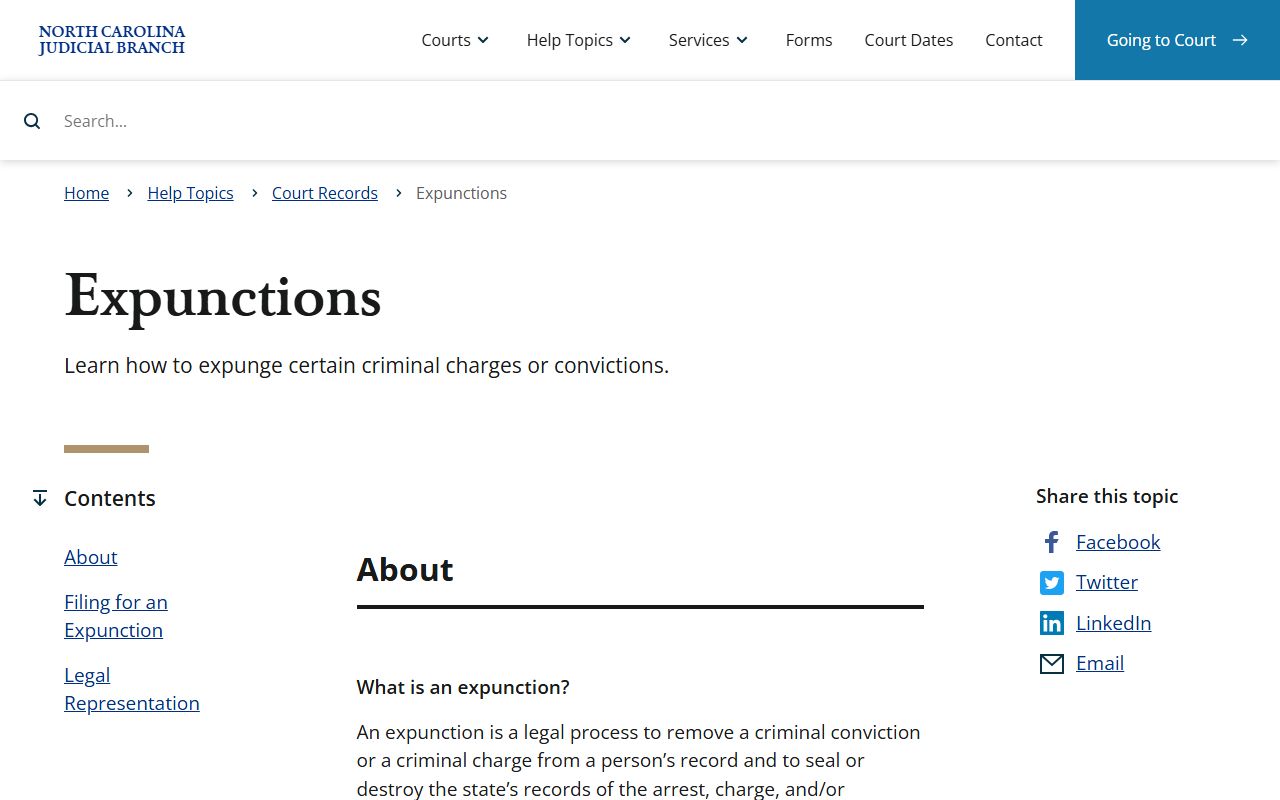
The guide is useful because expunction results affect whether Portal, terminals, and clerk sources continue to show the case.
Catawba Criminal Record Access
Public access begins with Portal, clerk terminals, and paper file review, but it is limited by court rules and confidentiality laws. G.S. 132-1 broadly defines public records, while court-specific statutes and rules govern how criminal case files are kept, searched, and redacted. Juvenile records, sealed files, expunged matters, mental health materials, and personal identifiers do not become public just because a docket entry exists.
North Carolina Indigent Defense Services lists Catawba as Defender District 25B and directs users to the Clerk of Superior Court at (828) 695-6100 to find out if they have a lawyer. That matters when a criminal court record shows counsel entries or when a defendant needs case information but does not know assigned counsel.
The manifest image from NC Indigent Defense Services Catawba County connects criminal records to appointed-counsel lookup channels.
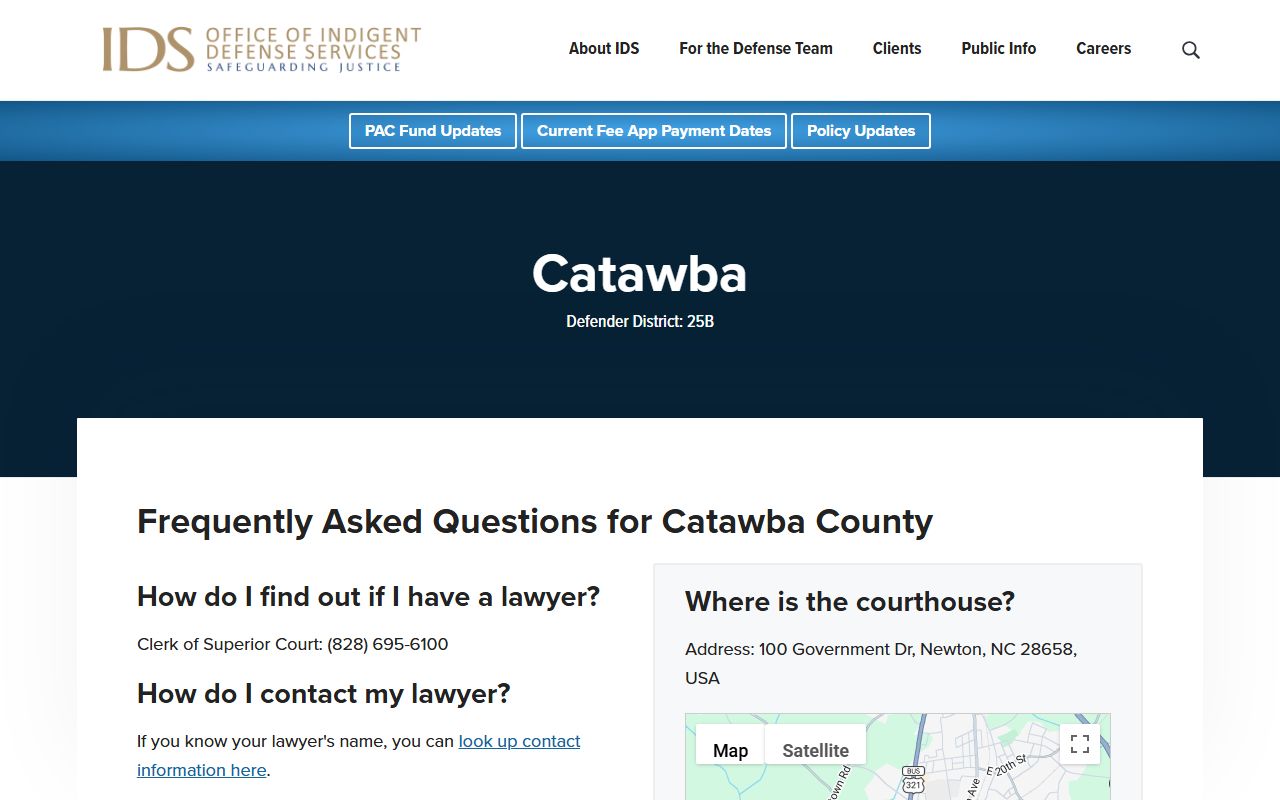
Defense counsel information can be part of a case file, but attorney assignment questions route through the clerk or IDS resources.
Important: Criminal court records should not be used for FCRA-regulated screening unless obtained through a compliant process.